

A good crochet hook organizer is not simply the case with the most slots. It is the one that closes comfortably around your longest hook, widest handle and smallest loose notions—and still lets you find the size you need without emptying the whole case.
Start by measuring the tools you own. Slim single-ended hooks often work beautifully in a roll. Mixed collections and wide ergonomic handles usually need a structured zip case with more clearance. Long Tunisian or double-ended hooks need full-length protection, while a desk holder is best for hooks that stay within reach at home. Your project bag should carry only the hook and notions for the project in progress, not your entire collection.
This guide walks through that fit test so you can choose between cases, rolls, holders and project bags with fewer compromises.
Measure the hooks before counting organizer slots

Slot count is an easy number to compare, but it tells you very little about fit. A case advertised for twenty hooks may be less useful than a twelve-slot case if its loops are too narrow for your handles or too shallow to hold them securely.
Lay the collection on a flat surface and record four things:
- The longest overall length. Measure from the tip of the hook head to the end of the handle. Include Tunisian hooks, double-ended hooks and any hooks attached to fixed cables.
- The widest handle. Measure or compare the thickest grip, not only the metal or wood shaft. Ergonomic, resin and handmade handles often need substantially more room than slim aluminum hooks.
- The largest hook head. A deep hook head can catch on a tight elastic loop even when the shaft fits.
- The loose parts. Note cables, connectors, end stops, stitch markers, tapestry needles, a tape measure and small scissors. These need closed pockets rather than unused hook loops.
Common single-ended hooks are often around 5.5 to 6 inches long, while Afghan or Tunisian hooks may be much longer. Those typical dimensions are a useful warning, not a substitute for measuring your own set. Handmade handles, interchangeable systems and specialty hooks vary.
Then make a paper footprint. Place the widest and longest tools on a sheet of paper with the spacing you would want inside a case. Mark the outline, fold the paper around it and see how much room the collection needs when closed. This simple mock-up is more informative than a product photo taken with very slim hooks.
Leave a little clearance around hook heads and textured grips. A closure should contain the tools without pressing one hook into another. If you have to force the zipper around the handles, the organizer is too shallow or too full.
Match the organizer to the hook profile
Different hook families create different storage problems. If you are still deciding which tools belong in your collection, the Dr.SheKnit overview of crochet hook families explains the main formats. For storage, the useful distinction is their physical footprint.
Slim single-ended hooks
Traditional aluminum, steel, bamboo and many wood hooks are straight and relatively slim. They are the easiest group to store because they can sit close together in stitched channels or elastic loops.
A roll is a strong choice when every hook is close to the same length. Look for channels deep enough to cover much of the shaft and a retaining flap that folds over the heads before the roll closes. Without that flap, hooks can slide out when the roll is carried vertically or picked up from the wrong end.
If you prefer a zip case, check that the elastic holds the shafts without gripping so tightly that the hook heads snag during removal. A size label beside each channel is helpful, but an open slot should remain obvious when a hook is in use.
Wide ergonomic, resin and handmade handles
Wide handles need spacing and depth. A standard elastic board may technically accept the narrow shaft while leaving the grip pressed against neighboring tools. That makes the case bulky and can turn every retrieval into a small rearrangement.
Choose wider loops, alternating loop positions or a case with a roomy central cavity. A structured shell helps the case keep its shape when the handles are different thicknesses. Before buying, compare the internal depth with the thickest handle—not the exterior dimensions alone.
For very sculpted or handmade handles, individual sleeves can be more practical than elastic. They reduce contact between raised decorations and make it easier to remove one hook without disturbing the row.
Tunisian, double-ended and cabled hooks
Long rigid hooks should lie flat at their full length. Do not angle them into a short case or leave their ends projecting from an open cup. A long zip sleeve, brush-style art case or purpose-built Tunisian hook case is usually a better match than a standard crochet roll.
Double-ended hooks also need protection at both ends, so a sleeve with a secure closure is more useful than a pocket that leaves one hook head exposed. For hooks with flexible cables, store the cable in a relaxed curve instead of creating a sharp fold. Removable cables, end stops and connectors belong in a small labeled zip pocket.
If your craft storage includes interchangeable knitting needles or their cables, keep that system separate so parts are not confused. Our knitting needle storage guide covers the different demands of circular needles, straight needles and knitting notions.
Compare rolls, zip cases, desk holders and project bags
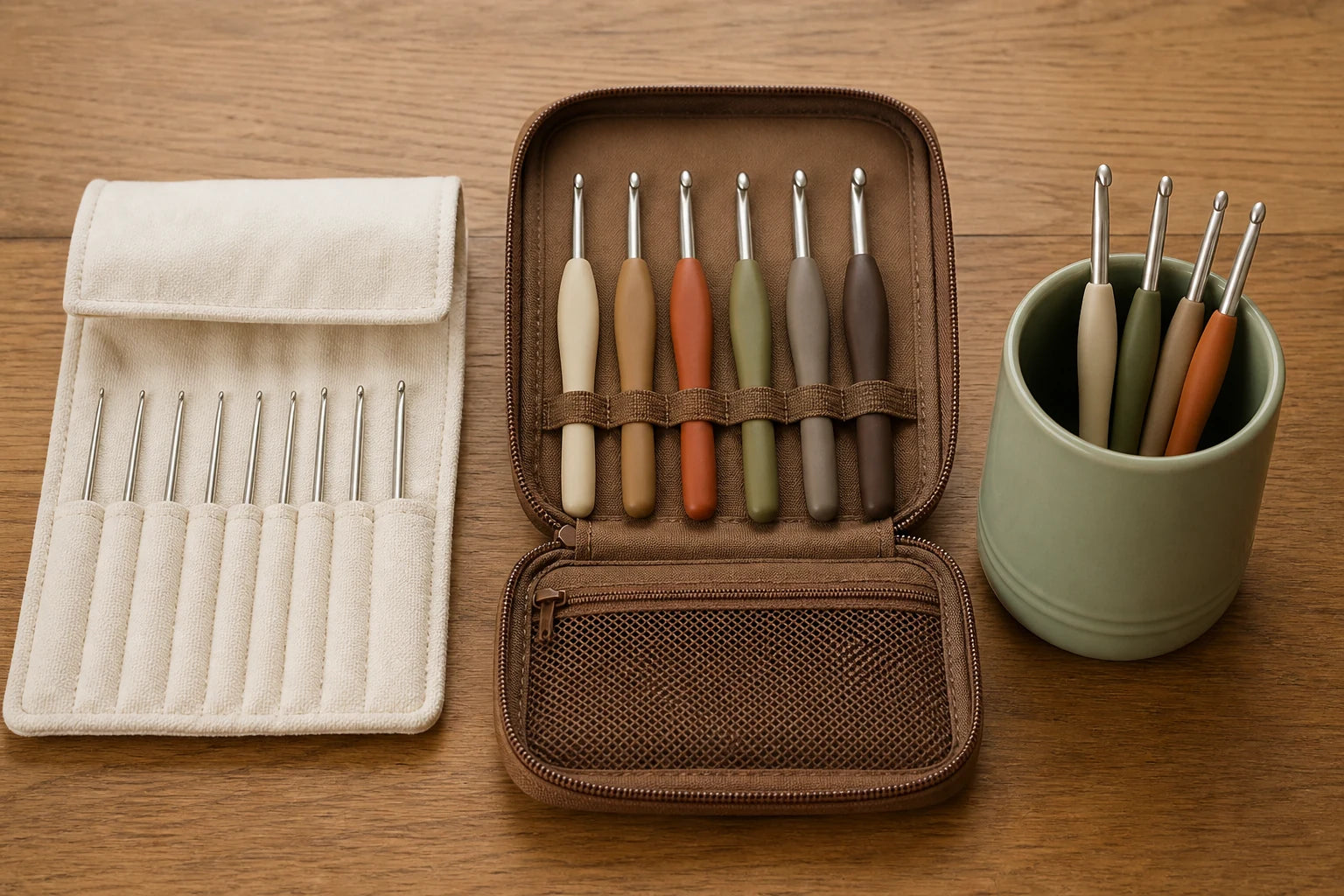
No single format wins every category. Let the hooks' usual destination decide: a fixed home workspace, regular travel or one active project.
| Organizer format | Best for | Check before choosing | Main limitation |
|---|---|---|---|
| Hook roll | Slim, similarly sized single-ended hooks | Channel depth, retaining flap and tie security | Wide handles or long hooks may not fit |
| Structured zip case | Mixed sets, ergonomic handles and portable collections | Internal depth, loop width, zipper clearance and closed notions pockets | Easy to overfill if every pocket becomes storage |
| Desk holder or cup | Frequently used hooks in a fixed workspace | Stable base, visible sizes and protected location | Open storage collects dust and is poor for transport |
| Long sleeve or specialty case | Tunisian, double-ended and long rigid hooks | True internal length and protection at both ends | Less convenient for short hooks and small notions |
| Project bag with tool compartment | One active hook, yarn and current notions | Tool retention, separate sharp-items pocket and bag closure | Not an ideal permanent archive for the full collection |
When a crochet hook roll makes sense
A roll is compact, quiet and easy to scan. Open it flat and every stored hook can have a predictable position. It also uses little shelf space once rolled.
Its weakness is retention. Deep channels and a top flap matter more than decorative fabric. Test the roll by filling it, fastening it, lifting it vertically and gently changing its orientation. If hooks migrate toward the opening, the channels are too shallow or the flap does not cover enough of the tool.
Fabric rolls also have a practical capacity limit. Once thick handles stack into a bulky cylinder, a structured case will usually close more cleanly.
When a structured crochet hook case is better
A zip case is the most adaptable choice for a mixed collection. It can combine elastic loops, sleeves and closed mesh pockets, and its perimeter zipper contains tools from every direction.
Look at the hinge area when the case is open. Hooks should remain clear of the zipper track and should not collide at the center fold. Closed, the case should have enough depth that handles on opposing panels do not press together.
A light-colored interior can make small dark tools easier to see. Clear or mesh pockets are useful for notions, provided the zipper pull cannot scratch adjacent handles. A removable insert is helpful only if it remains secure when the case is carried.
When an upright holder is enough
An upright holder works well beside a favorite chair or on a stable craft desk. It gives fast access and makes a small working group visible. It is especially useful when you repeatedly reach for the same few sizes.
Treat it as a working station, not a complete storage system. Keep it away from table edges, curious pets and places where a sleeve can catch the hooks. Do not crowd fine steel hooks beneath heavy handled hooks where the small tools disappear. If size markings sit low on the handles, arrange the holder so you can still read them.
When the project bag should carry the tools
A project bag is for the current project kit: the selected hook, working yarn, pattern and the notions required for that task. This keeps the project ready to pick up without turning the bag into permanent storage for every hook you own.
A bag with a dedicated tool panel can be useful when you work away from home, but loose hooks should not share the main compartment with yarn. They can disappear into the project, catch on openwork or fall out when the yarn is lifted. Our project-bag travel guide has more detail on closures, portability and packing for craft sessions away from home.
Give long and cabled hooks their full length
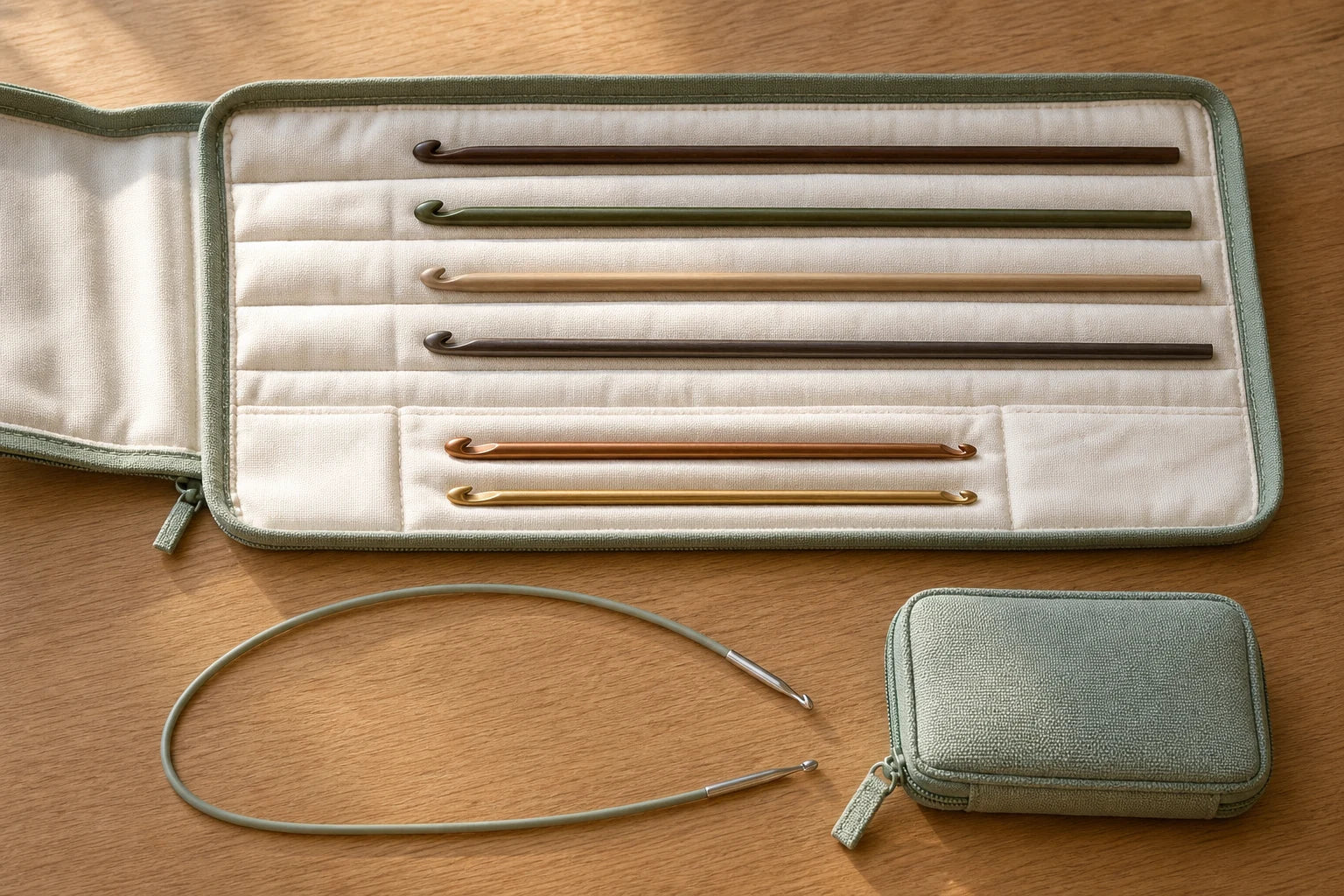
Specialty hooks are the tools most likely to be compromised by a general-purpose organizer. Measure the organizer's usable internal length rather than trusting its exterior length. Seams, padding and zipper curves reduce the space inside.
For a long rigid Tunisian hook, allow room for the head and end stop without forcing either one against the case wall. A case that bows when zipped is not offering real protection. Store double-ended hooks in a fully enclosed channel so neither end can work free.
Cabled hooks need two storage decisions: where the hook sits and how the cable rests. A wide loop is better than a tight coil. For an interchangeable system, keep each cable and its end stops together in a labeled pocket. Place small connector tools in a tiny envelope or inner pouch inside it so they do not slip through mesh.
If your long hooks are used only occasionally, they can occupy a separate flat sleeve stored beside the main case. There is no requirement that one organizer hold every crochet tool. A compact everyday case plus a specialty sleeve is often clearer than one oversized case with awkward empty areas.
Make every hook size visible when one leaves the case
An orderly row can still fail if there is no way to identify the hook currently in a project. Size markings wear, handmade grips may cover original labels, and US letters do not always map consistently across brands.
Create a simple size map for the organizer. Write the metric diameter beside each channel or loop and add the US designation only as a secondary reference. Metric size is the more reliable inventory key. If a manufacturer's marking differs from a generic conversion chart, keep the manufacturer's stated metric size with that hook.
Use removable labels or a card tucked into the case rather than writing directly on a valuable handle. When a hook leaves its slot, place a small project tag in the empty space. The tag can name the project and the hook size, so you know whether a gap means “in use” or “missing.”
Group hooks in a sequence that matches how you search. Ascending metric size is the clearest default. If you own two distinct families—such as slim steel hooks for thread and ergonomic hooks for yarn—separate them into labeled rows instead of forcing them into one continuous scale.
An inventory check may reveal meaningful gaps or unnecessary duplicates. If you prefer a coordinated range, browse crochet hook sets after you know which sizes and handle profiles fit your work. The organizer should support the collection you actually use, not create pressure to fill every empty loop.
Pack one active crochet project kit
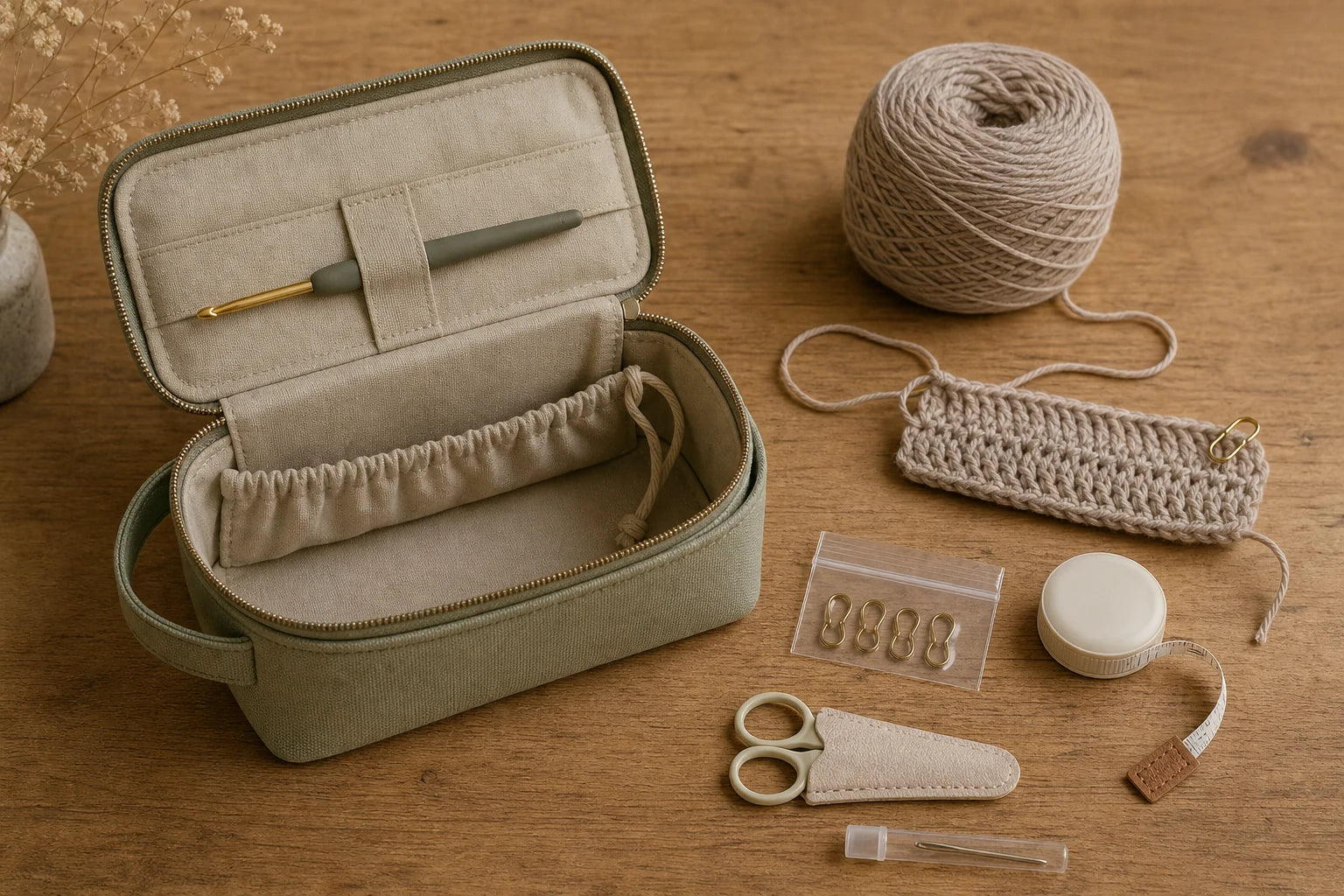
The full hook collection can stay in its home organizer. For each active project, move only the selected hook and the smallest useful notion kit into the project bag.
A practical project kit usually includes:
- the hook named in your working notes, plus a backup only when there is a real reason;
- the yarn and work in progress;
- a small number of locking stitch markers;
- one tapestry needle in a protective tube or closed pocket;
- compact scissors with the blades closed or covered;
- a flexible tape measure;
- a row counter or note card if the pattern requires one.
Keep the hook in a loop, sleeve or flat-opening tool panel rather than dropping it beside the yarn. The exact slot acts as a visual check before you leave a class, café or friend's home. Put the tool back immediately after a pause instead of resting it in the fold of the project.
This separation also protects your home inventory. You will not repeatedly unpack the master case or wonder whether a missing hook is in a tote, a sofa cushion or another project. When a project ends, return the hook, remove the project tag and empty the notions pocket before packing the next kit.
Yarn needs a different storage plan from hooks. The project bag holds the working supply, while the larger stash benefits from its own grouped, protected home. See our guide to an organized yarn stash for that wider system.
Keep tiny and sharp notions away from hook handles
Small notions deserve one closed, visible pocket. Open exterior pockets and shallow slip pockets are easy to forget when the organizer is lifted. A zipper or secure flap keeps markers and tapestry needles from migrating into the hook area.
Separate items by risk, not only by size. A bare tapestry needle should not float beside a soft-grip handle. Scissor blades should close fully, and a small protective sleeve is worthwhile if the scissors share a pocket with a tape measure or cable. Point protectors, connector tools and end stops can be grouped in a tiny inner pouch.
Avoid turning the notions pocket into a miscellaneous drawer. Duplicate tape measures, old yarn labels, loose buttons and unrelated craft tools make the useful pieces harder to find. If an item has not served a crochet project recently, give it another home.
Visibility matters. A transparent pocket is convenient, but a pale solid pocket can work just as well if the contents are divided into two or three small pouches. The goal is to retrieve a marker or needle without tipping everything onto the table.
Run the close, lift and retrieval test
Once an organizer is filled, test it as a working tool. This exposes problems that are invisible in staged product photos.
- Close it without compression. Fasten every flap and zipper normally. Stop if the shell bows, the zipper pulls across a hook head or opposing handles press together.
- Lift and change orientation. Hold the organizer by its intended handle or carry point. Turn it vertical and gently rotate it. Nothing should slide from an open channel into the case cavity.
- Retrieve one hook. Choose a size, remove it and close the case. The remaining hooks should stay in position, and the empty slot should be easy to identify.
- Return it one-handed if practical. You should not need to remove several neighboring hooks or stretch an elastic loop aggressively.
- Check the notions pocket. Open it while the hook panels remain loaded. Tiny items should be contained and the zipper should not scrape nearby tools.
Repeat the test after a week of normal use. Elastic may relax, a tie may loosen and the project pocket may collect extras. Adjust the load before buying another organizer. Sometimes the fix is simply moving specialty hooks to a separate sleeve or reducing the active kit.
Also inspect the case periodically for grit, loose threads and damaged zipper teeth. Empty fabric cases according to their care instructions and let them dry completely before refilling. Wipe hooks according to the tool manufacturer's guidance, especially when they combine wood, metal, resin or soft-grip materials.
How Dr.SheKnit separates the collection from the project
At home, give the full hook collection a stable, size-mapped case or roll. That is the archive: every hook has a position, specialty tools have enough length and small components stay in closed pockets.
For the active project, use a smaller working system. The Dr.SheKnit quilted yarn storage bag with crochet hook organizer is one example of this second role. Its front compartment opens flat and includes elastic hook loops plus a transparent zip pocket for small tools. The main zip compartment holds the project and yarn, while side pockets can take longer tools. A top handle and removable adjustable shoulder strap support carrying, and six yarn outlet holes let working yarn feed from the bag.
The bag is approximately 12.6 by 11.02 by 8.27–8.66 inches depending on color. That is still a reason to measure: compare your own hook length, handle thickness and project size with the available compartments. Tools and yarn are not included, and the bag should be chosen for a compatible active project rather than treated as a universal case for every specialty hook.
This two-part approach keeps the master collection predictable while making the current project portable. It also means a temporary project change does not scramble the size order at home.
Crochet hook organizer FAQ
What is the best way to organize crochet hooks?
Measure the longest hook and widest handle, then choose a format that closes without compression. Arrange hooks by metric size, give long or cabled hooks a separate full-length sleeve when needed, and use closed pockets for tiny notions. Mark an empty slot when its hook is assigned to a project.
Is a crochet hook roll or case better?
A roll is compact and easy to scan for slim, similarly sized single-ended hooks. A structured zip case is usually better for mixed collections, wide ergonomic handles and portable notions because it offers more depth and all-around containment. The fit of your thickest handle should decide between them.
How do I store ergonomic crochet hooks?
Use wide loops, individual sleeves or a structured case with enough internal depth for the thickest grip. Close the loaded case to confirm opposing handles do not press together and hook heads stay clear of the zipper. Avoid forcing wide handles into narrow elastic made for slim shafts.
How should Tunisian crochet hooks be stored?
Store long rigid Tunisian hooks flat in a sleeve or case with enough usable internal length for the hook and end stop. Let flexible cables rest in a wide curve. Keep removable cables, connectors and end stops together in a small closed, labeled pocket.
What should go in a crochet project bag?
Pack the current project, working yarn, selected hook and a compact notion kit such as stitch markers, a protected tapestry needle, closed scissors and a tape measure. Leave the rest of the hook collection in its home organizer so the project bag stays light and missing sizes remain easy to trace.
Choose from the footprint, not the slot count
The most useful crochet hook organizer reflects the shapes of your real tools. Measure first, choose retention and depth second, and count slots only after the collection fits. A roll can serve slim hooks, a structured case can manage mixed handles, a long sleeve can protect specialty hooks and a project bag can carry the one kit currently in use.
When you are ready to compare portable organizers and project storage, browse the Dr.SheKnit Storage collection. Keep your measurements nearby and choose the structure that lets every hook leave—and return to—an obvious home.