

An H-8 crochet hook is 5.0 mm, not 8 mm. That single example explains why a crochet hook size chart is useful: US letters and numbers are labels, while the millimeter measurement describes the hook's actual shaft diameter.
Begin with the millimeter marking when a pattern, yarn label and hook seem to disagree. Then treat any yarn-weight recommendation as a starting range, not a rule. The pattern's gauge and your own swatch decide whether the fabric needs a smaller or larger hook.
The charts below cover regular crochet hooks, standard yarn-weight ranges and the direction to move when gauge is off. Steel thread hooks use a different numbering system and are kept separate.
Read the millimeter marking before the US letter
Regular crochet hooks may carry a US letter, a number, a metric size or several markings at once. The metric number is the clearest comparison point because it states the shaft diameter in millimeters. A 5.0 mm hook remains 5.0 mm even when one maker stamps it H-8 and another uses a slightly different label.
The Craft Yarn Council notes that US letter and number sizes can vary by manufacturer. That variation is especially visible around sizes that have more than one historical designation. It also explains why some rows in a reliable conversion chart have no universal US equivalent.
When reading a pattern, use this order:
- Find the metric size printed beside the US label.
- Check the same millimeter marking on your hook.
- Crochet the pattern's stated gauge swatch.
- Change hook size only after measuring the swatch.
Never convert an H-8 by treating the 8 as millimeters. In the common US system, the number is part of the label. H-8 corresponds to 5.0 mm in the Craft Yarn Council chart.
Regular crochet hook size chart

This table follows the Craft Yarn Council's listed equivalents for regular crochet hooks. It is a reference for common modern labels, not proof that every vintage or manufacturer-specific hook uses the same stamp.
| Metric size | Common US size | Practical note |
|---|---|---|
| 2.25 mm | B-1 | Often used with very fine yarns. |
| 2.50 mm | No universal US label | Read the metric marking. |
| 2.75 mm | C-2 | Fine-yarn range. |
| 3.125 mm | D | Less common intermediate size. |
| 3.25 mm | D-3 | Check whether a pattern states 3.125 or 3.25 mm. |
| 3.50 mm | E-4 | Common for fine and light yarns. |
| 3.75 mm | F-5 | Intermediate light-yarn size. |
| 4.00 mm | G-6 | Common light-yarn starting point. |
| 4.25 mm | G | Manufacturer labels may differ. |
| 4.50 mm | 7 | Common transition between light and medium ranges. |
| 5.00 mm | H-8 | The “8” is not 8 mm. |
| 5.25 mm | I | Intermediate size; verify the metric value. |
| 5.50 mm | I-9 | Common medium-yarn size. |
| 5.75 mm | J | Intermediate size; verify the metric value. |
| 6.00 mm | J-10 | Common medium-to-bulky transition. |
| 6.50 mm | K-10½ | Common bulky-yarn starting point. |
| 7.00 mm | No universal US label | Use the metric measurement. |
| 8.00 mm | L-11 | Often used for bulky yarn and open fabric. |
| 9.00 mm | M/N-13 | One metric size may have a combined US label. |
| 10.00 mm | N/P-15 | Large regular hook. |
| 11.50 mm | P-16 | Not the same as every hook marked P. |
| 12.00 mm | No universal US label | Use the metric measurement. |
| 15.00 mm | P/Q | Jumbo range. |
| 15.75 mm | Q | Check the actual shaft diameter. |
| 16.00 mm | Q | Same US letter may appear beside nearby metric sizes. |
| 19.00 mm | S | Jumbo range. |
| 25.00 mm | T/U/X | Multiple labels appear in use. |
| 30.00 mm | T/X | Metric marking is the useful identifier. |
Source: Craft Yarn Council, Hooks & Needles.
A blank US size is useful information
A blank cell does not mean the hook size is invalid. It means there is no single US letter or number that the standard can present as a dependable equivalent. A 7.0 mm hook is still a precise size; it simply works better as a metric reference.
This matters when buying an individual hook to fill a gap. A pattern asking for 7.0 mm calls for a 7.0 mm search rather than a guess between nearby letters. It also matters when organizing a collection. Arrange hooks by metric diameter so an unlabeled US cell does not create a false gap.
Why neighboring charts sometimes disagree
Conversion charts can differ because manufacturers, regions and older systems have not always used identical labels. Handmade hooks may also have a handle that hides the original stamp. A generic chart can translate the most common convention, but it cannot overwrite the diameter of the tool in your hand.
A hook with both metric and US markings should be recorded by its metric value. With only a US label, compare it with the manufacturer's own chart when available. For an unmarked hook, measure the shaft with a hook gauge tool rather than the head or handle.
Match yarn weight to a starting hook range

Yarn weight describes a category, not an exact diameter. Two yarns labeled Medium 4 can differ in fiber, twist, loft and construction. That is why each weight maps to a range of hook sizes rather than one mandatory hook.
| CYC yarn weight | Common name | Regular crochet hook starting range |
|---|---|---|
| 0 | Lace | 2.25 mm regular hook; steel 1.4–1.6 mm may also be listed. |
| 1 | Super Fine | 2.25–3.5 mm. |
| 2 | Fine | 3.5–4.5 mm. |
| 3 | Light | 4.5–5.5 mm. |
| 4 | Medium | 5.5–6.5 mm. |
| 5 | Bulky | 6.5–9.0 mm. |
| 6 | Super Bulky | 9.0–15.0 mm. |
| 7 | Jumbo | 15.0 mm and larger. |
Source: Craft Yarn Council Yarn Weight System. The published ranges are guidelines. Lace projects may deliberately use a larger hook to create open fabric.
Turn to the yarn table when no pattern is available or when you are planning a swatch. When a pattern names a different hook, start there because its designer chose a tool for a particular stitch pattern, fabric and finished measurement.
Pattern, ball band or chart: which one wins?
The three references answer different questions.
| Reference | What it tells you | When to use it |
|---|---|---|
| Pattern | The designer's starting hook and target gauge | First choice for a specific project. |
| Yarn ball band | A general range for that yarn | Useful when planning without a pattern. |
| Yarn-weight chart | A category-level starting range | Useful for comparison and first swatches. |
| Your gauge swatch | How your hands, hook and yarn behave together | Final decision for fit and fabric. |
The pattern is the starting instruction; the swatch is the test. A ball band and yarn-weight chart cannot account for your tension, the exact stitch or the designer's intended drape.
Let the swatch outrank the chart
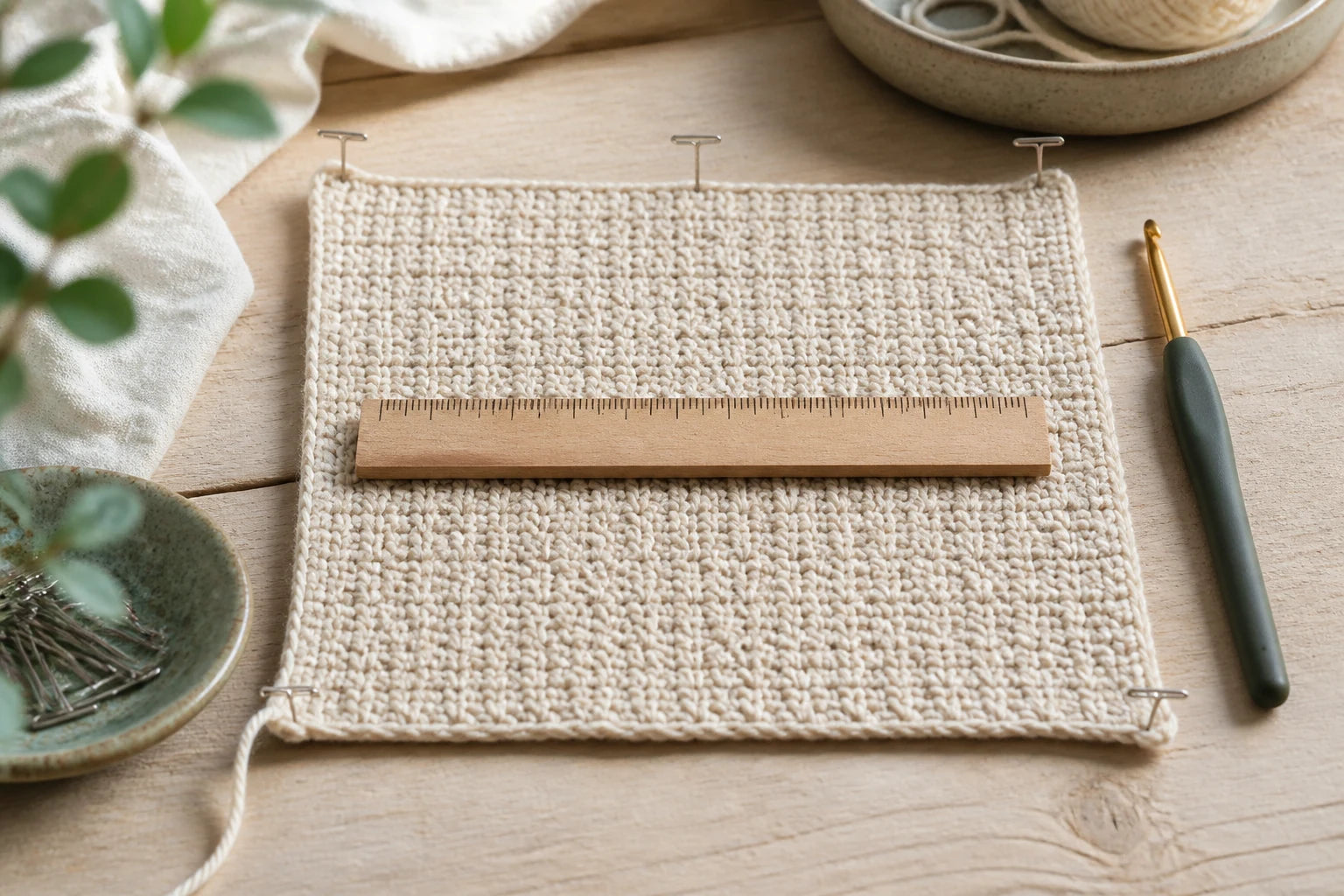
Gauge is usually written as stitches and rows over a measured distance, commonly four inches or ten centimeters. Crochet a swatch larger than the measurement area, let it rest or block it as the pattern instructs, then measure in the center rather than along an uneven edge.
Count the stitches across the stated width and the rows across the stated height. Compare both numbers with the pattern. A hook change most directly affects stitch size, but yarn behavior, stitch height and personal technique can influence row gauge as well.
The basic correction is:
| Swatch result | What it means | First adjustment |
|---|---|---|
| Swatch is too large, or too few stitches fit the measured width | Your stitches are larger than the target | Try a smaller hook. |
| Swatch is too small, or too many stitches fit the measured width | Your stitches are smaller than the target | Try a larger hook. |
| Stitch gauge matches but row gauge does not | Stitch height or technique differs | Review pattern guidance before changing only for rows. |
| Gauge matches but fabric feels wrong | Size is correct, fabric character is not | Reconsider yarn construction or test a nearby hook while protecting gauge. |
Change one step at a time and label each swatch with its metric hook size. “One step” means the next useful metric size in your set, not necessarily the next US letter. Near common garment sizes, that may be a 0.25 or 0.5 mm move. With jumbo hooks, the interval may be much larger.
A worked gauge example
Suppose a pattern asks for 16 stitches across four inches with a 5.0 mm H-8 hook. Your washed swatch measures four and a half inches across the same 16 stitches. The fabric is wider than the target, so your stitches are too large. Test the next smaller metric hook available, such as 4.5 mm, and swatch again.
A measurement of only three and a half inches across the same 16 stitches means the fabric is too narrow and the stitches are too small. Test a larger hook, such as 5.5 mm. The US letters are secondary; the metric move shows exactly what changed.
For a fitted garment, repeat the swatch until both gauge and fabric are acceptable. For a scarf, blanket or decorative item where exact finished dimensions are flexible, you may prioritize the fabric you like and recalculate dimensions or yarn needs. The project instructions should state whether size accuracy is critical.
The same yarn can make dense or open fabric
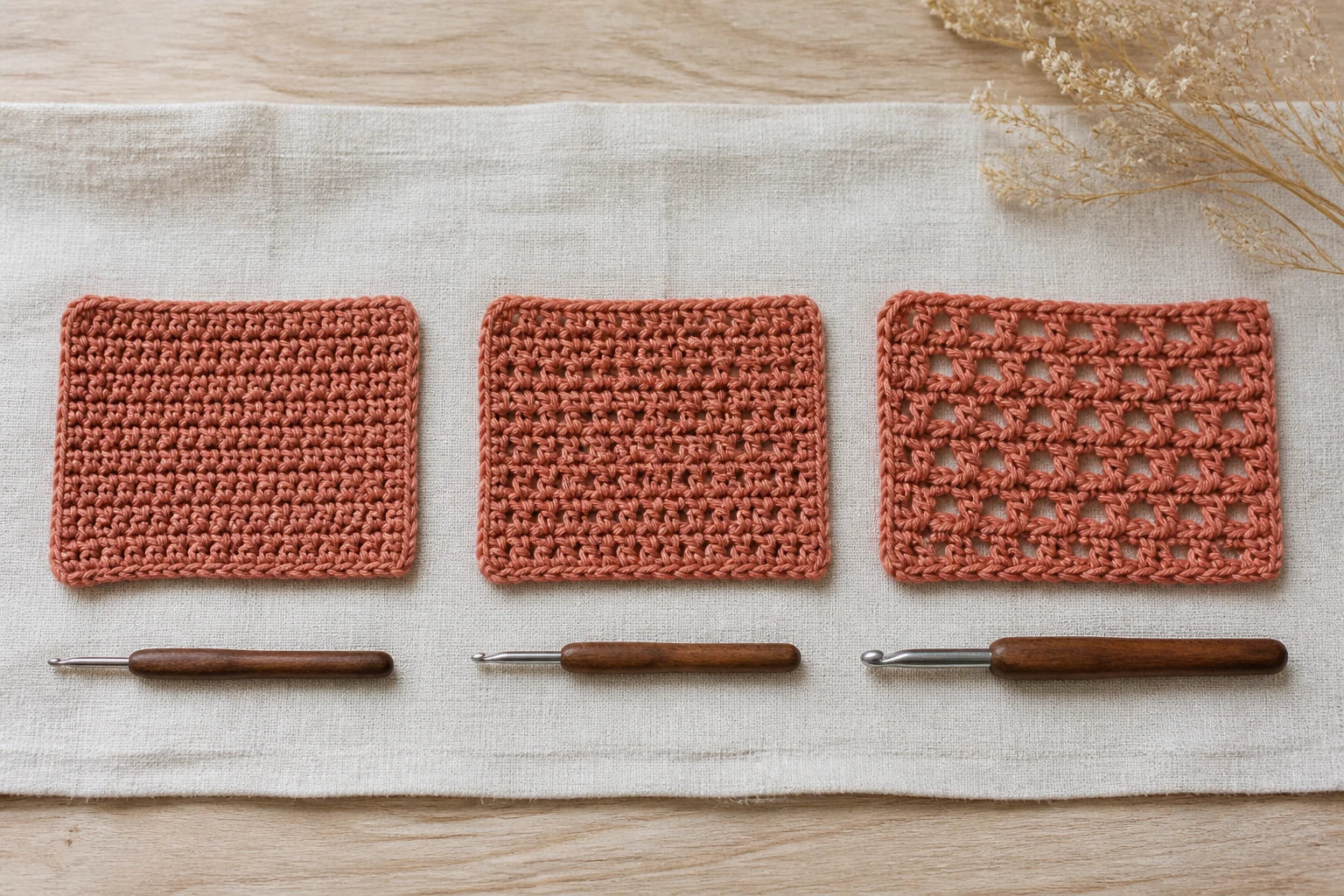
A hook chart cannot describe fabric on its own. Pair the same yarn with three hook sizes and the stitches can shift from compact to balanced to open.
A smaller hook tends to make tighter, denser fabric. That can suit firm baskets, some toys or sections that need structure, but an excessively small hook can make the work stiff and harder to handle. A hook near the yarn's usual range often creates a balanced fabric for general garments and accessories. A larger hook opens space between stitches, increasing drape and making lace structures more visible.
Stitch pattern changes the result too. Single crochet builds a different surface from double crochet, mesh, shells or puffs. Textured stitches can consume more yarn and feel firmer. Slip-stitch fabrics may need more room than a chart suggests. Lace may use a hook far above the yarn's usual range because open space is part of the design.
Fiber and construction matter. A lofty wool can fill space after washing; a smooth cotton may show every gap; a chainette or brushed yarn may look fuller than its core. Two Medium 4 yarns can therefore need different hooks for the same visual result. Yarnspirations similarly advises that hook choice depends on yarn, gauge and stitch pattern, and that yarns within one weight category are not identical.
Let the chart choose the first swatch. Let the swatch choose the fabric.
Keep steel crochet hooks in a separate size system
Fine steel hooks are commonly used with crochet thread and very fine yarn. Their numbering runs in the opposite direction from regular hook sizing: as the steel-hook number gets higher, the hook gets smaller. That reversal makes it risky to merge steel and regular labels in one organizer row or one simplified chart.
For example, a regular US size 7 is associated with a 4.5 mm hook in the table above. A steel hook carrying a 7 is a much finer tool. The shared number does not mean shared diameter.
Store steel hooks separately and label them with millimeters whenever possible. For a vintage steel hook carrying only a number, consult the maker's documentation or a physical hook gauge designed for fine sizes. Never infer its diameter from the regular-hook chart.
Patterns for thread crochet may specify both the steel number and metric diameter. Match the metric value, make a small test section and inspect whether the thread moves cleanly through the hook throat. Very fine differences are meaningful at that scale.
Measure an unlabeled hook at the shaft
The sizing diameter is measured on the shaft, the straight section behind the hook head. Avoid measuring across the widest part of the head, the grip or a decorative handle.
A hook gauge tool has calibrated holes. Slide the shaft into the smallest hole it enters without force, then read the millimeter label. The shaft should fit cleanly rather than wedge into the opening. Some ergonomic hooks have only a short exposed shaft; use the straight, consistent section that remains accessible.
Digital calipers can provide another measurement, but soft coatings, tapered shafts and user pressure can distort the reading. A purpose-made gauge is faster for routine identification. Whichever method you use, attach a removable metric label to the hook or record the size in your organizer.
On a shaft tapered over most of its length, measure where the working loops normally rest. Handmade hooks can be intentionally nonstandard, so treat the measured value as that hook's identity rather than forcing it into the nearest US letter.
The newly published crochet hook organizer guide explains how to map metric sizes to slots and mark a hook that has left the case for an active project.
Build a useful set around metric coverage
A useful set covers the yarn and projects you actually crochet. It does not need every US letter, especially where two labels overlap or no universal equivalent exists.
Start with your recent patterns. List the metric hook used for each one, then note nearby sizes you needed for gauge correction. The repeated range is your working core. A maker who uses mostly Super Fine through Medium yarn may value close spacing from 2.5 to 6.5 mm. Someone working with Bulky and Super Bulky yarn may care more about 6.5 through 15 mm.
Check spacing as well as endpoints. A set advertised as 2–8 mm can be very useful, but the exact included increments determine whether it supports small gauge adjustments. Read the individual size list rather than assuming every quarter- or half-millimeter size is present.
Keep duplicates only when they have a job: one hook lives with a long-running project, a second has a different handle, or two makers produce meaningfully different results. Otherwise, a clear metric sequence is easier to use than a crowded case.
If you are comparing formats before filling gaps, the Dr.SheKnit crochet hook overview separates common hook families, while the crochet hook sets collection provides coordinated size ranges.
How Dr.SheKnit covers everyday and larger sizes
Dr.SheKnit's ranges can be read by millimeter coverage rather than by a promise that one set fits every project.
The Floral Resin Ergonomic Crochet Hooks CH172 cover 2.0–8.0 mm. That span crosses fine through many bulky-yarn starting points, depending on the exact sizes included and the gauge your project requires.
For larger work, the Cherry Two-Tone Large Crochet Hooks CH166 cover 6.0–12.0 mm. That range overlaps the upper medium area and extends through bulky and part of the super-bulky starting range.
These ranges are product facts, not universal yarn matches. Read the pattern, check the exact included sizes on the product page and swatch with your yarn. Availability and pricing can change, so they are not part of this reference.
Crochet hook size FAQ
What size is an H crochet hook in millimeters?
The common H-8 regular crochet hook is 5.0 mm in the Craft Yarn Council chart. The 8 is part of the US designation, not the metric diameter. Verify the millimeter stamp because manufacturer conventions can vary.
What crochet hook size should I use for Medium 4 yarn?
The Craft Yarn Council lists 5.5–6.5 mm as a starting range for Medium 4 yarn. A specific pattern may use a smaller or larger hook for gauge, structure or drape, so follow the pattern and test a swatch.
Is a 4.0 mm crochet hook a G or H?
The common regular-hook chart lists 4.0 mm as G-6. H-8 is commonly 5.0 mm. Because US labels can vary, use the metric marking when precision matters.
Should I use a smaller or larger hook when my swatch is too big?
Use a smaller hook when the swatch is too large or too few stitches fit the target width. Use a larger hook when the swatch is too small or too many stitches fit the target width. Change one metric step and measure again.
Are steel crochet hook sizes the same as regular hook sizes?
No. Steel-hook numbering is a separate system commonly used for thread, and higher steel numbers indicate smaller hooks. Keep steel hooks separate and compare millimeter diameters rather than matching the printed number to a regular hook.
How can I identify a crochet hook with no size marking?
Measure the straight shaft with a crochet hook gauge tool. Select the smallest calibrated hole the shaft enters without force, record the millimeter value and add a removable label or organizer note.
Keep millimeters beside every project
Save the metric hook size with the pattern, yarn and gauge result. That one habit removes most conversion ambiguity. The US label helps you recognize a familiar size; the millimeter value lets you compare tools accurately.
Start with the chart, select a hook from the pattern or yarn range, and let the swatch decide the final size. When you need coordinated coverage, compare Dr.SheKnit crochet hook sets by their exact millimeter increments and the projects already in your queue.